
A different conversation about the daily drive
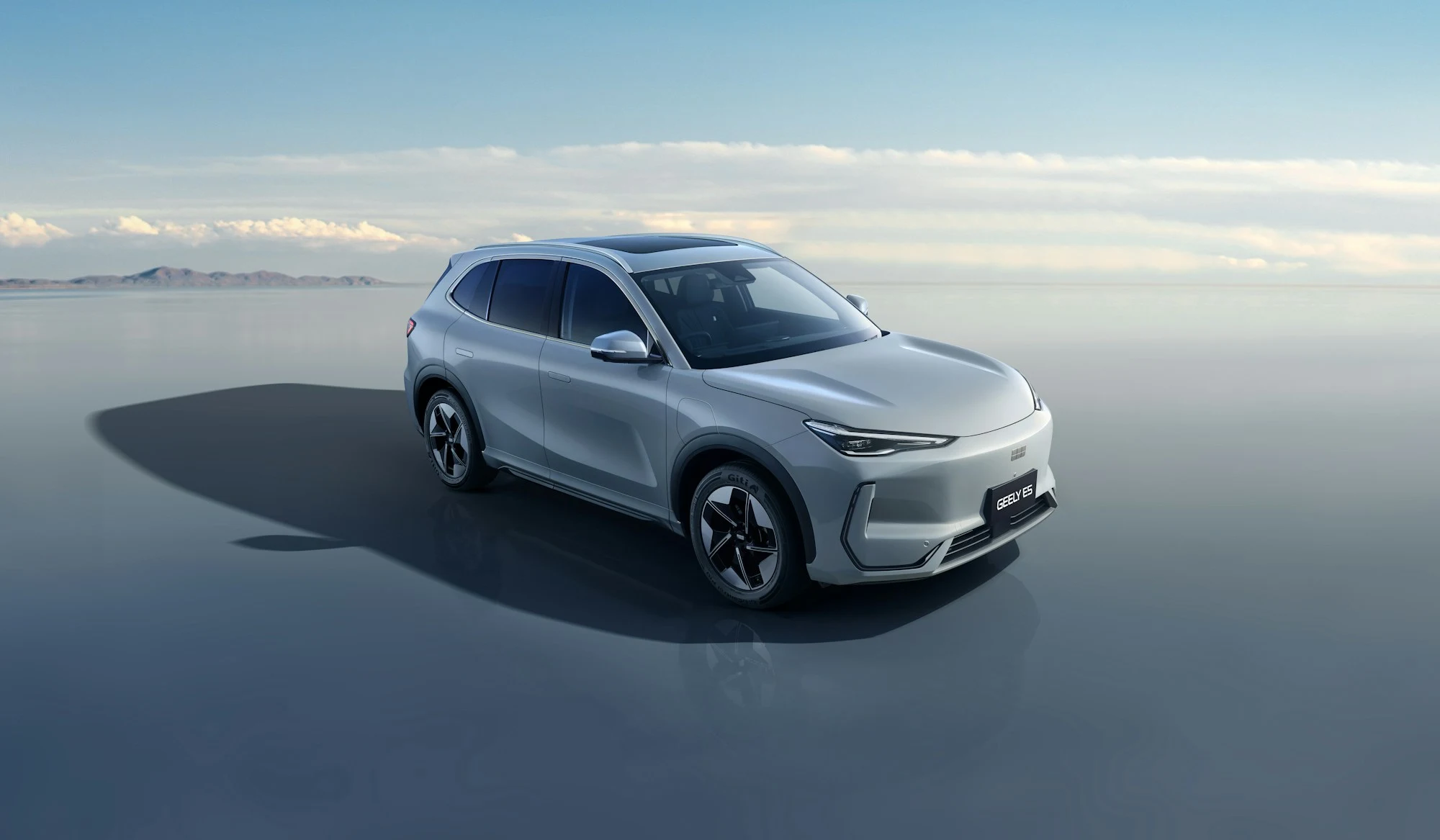
For South African motorists, the next fuel-price announcement can change the cost of getting to work, taking children to school and visiting family. The Geely E5 makes another approach possible: a family SUV powered entirely by a rechargeable battery, with no petrol engine to fill up.
Geely introduced the E5 to South Africa in November 2025 alongside the E5 EM-i. The distinction matters: the E5 is fully electric, while the EM-i combines electric driving with a petrol engine. The E5 joins a growing electric-vehicle market, giving more households a reason to consider whether their next car needs petrol at all.
Why imported fuel makes this a South African story
The Department of Mineral and Petroleum Resources explains that South Africa imports both crude oil and finished petroleum products. International prices, shipping costs and the rand-dollar exchange rate feed into local fuel pricing, alongside levies and other domestic factors.
That exposure is tangible. The department’s October 2026 update announced petrol increases of R3.12 per litre for 93 octane and R3.33 for 95 octane, effective 7 October. These are dated adjustments, rather than a prediction of what petrol will cost next month.
An E5 driver buys electricity for driving instead of petrol. That removes direct petrol purchases from the household’s motoring routine. It does not make transport free or eliminate South Africa’s wider energy challenges, but it changes where a driver’s exposure to energy costs sits.
Electric driving with family life in mind
The appeal extends beyond the powertrain. Geely’s South African launch information describes a 461-litre boot and a cabin designed around family use. Its current local model page lists claimed electric ranges of 430 km for Aspire, 410 km for Apex and 450 km for Apex Plus.
Those figures are test-cycle claims, not a promise for every journey. Speed, weather, load and driving style affect the distance between charges. Plan around your actual route and the derivative you are considering.
The real question: where will you charge?
Before comparing running costs, map out your charging routine. Can the car charge where it is parked overnight? What installation work is needed? Which public chargers serve the routes you regularly travel, and what do they charge?
Cars.co.za’s August 2026 E5 road test highlights how much charging location can change the bill: its home, public AC and public DC examples had different electricity costs. A useful personal comparison should include your tariff, charging losses, installation, purchase price, insurance and your expected mileage. Savings depend on those inputs.
For households with suitable solar generation, charging can also become part of a home-energy plan. The available generation, charging time and installation all need to fit the way the household uses electricity.
What could you save over five years?
This worked example compares energy costs for the same 15,000 km a year: 75,000 km over five years. It assumes a petrol SUV using 8.0 L/100 km and an illustrative petrol price of R25.00/litre. These are comparison inputs, not a current pump-price quote or a claim about a particular petrol model.
For the E5, the calculation uses the Apex’s quoted 16.0 kWh/100 km and assumes 90% charging efficiency. That means buying about 17.78 kWh from the charger per 100 km. Electricity inputs of R3.50/kWh at home, R5.86/kWh on public AC and R8.24/kWh on public DC come from Cars.co.za’s August 2026 examples; they are not current tariff quotes. Each row assumes all charging happens at that rate.
| Driving / charging scenario | Per year | Over 5 years | 5-year energy saving |
|---|---|---|---|
| Petrol SUV comparison | R30 000 | R150 000 | — |
| E5: home charging | R9 333 | R46 667 | R103 333 |
| E5: public AC charging | R15 627 | R78 133 | R71 867 |
| E5: public DC charging | R21 973 | R109 867 | R40 133 |
Energy costs only, rounded to the nearest rand after calculation. Prices, consumption and annual distance are held constant; this is not a five-year forecast. Savings exclude purchase-price differences, finance, depreciation, insurance, maintenance, tyres, charger installation, solar equipment and any fixed charging fees. Actual driving, tariffs and charging losses will change the result.
- Petrol cost = distance ÷ 100 × 8.0 litres × R25.00.
- E5 cost = distance ÷ 100 × (16.0 kWh ÷ 0.90) × electricity tariff.
- Potential energy saving = petrol cost minus E5 charging cost. Use your own mileage, consumption and prices when comparing ownership costs.
Explore a new choice with your local team
The E5’s significance is the choice it brings to an everyday decision: how to power the kilometres that keep a household moving. In a country exposed to imported fuel and changing pump prices, that is a conversation worth having.
Speak to Geely Paarl about the E5, current availability and a test drive. Bring your daily distance, regular longer trips and charging questions so the team can help you compare electric ownership with your own routine.
Sources & further reading
Sources for the background and figures in this story.
- Geely Auto: South African launch of the E5 and E5 EM-i · 19 November 2025
- Geely Auto South Africa: E5 launch details and campaign image · 19 November 2025
- Geely Auto South Africa: current E5 electric SUV range
- DMPR: fuel imports and the factors behind local fuel prices · 31 August 2026
- DMPR: fuel price adjustments effective 7 October 2026 · 7 October 2026
- Cars.co.za: Geely E5 (2026) independent road test · 4 August 2026